

As your AI product grows or you expand your automation pipeline, inference costs can rise quickly. Responses start taking longer, GPU memory fills up, and adding capacity starts to look like the only option.
But before paying for more hardware, ask a simple question: Is your current serving stack making the best use of your GPU?
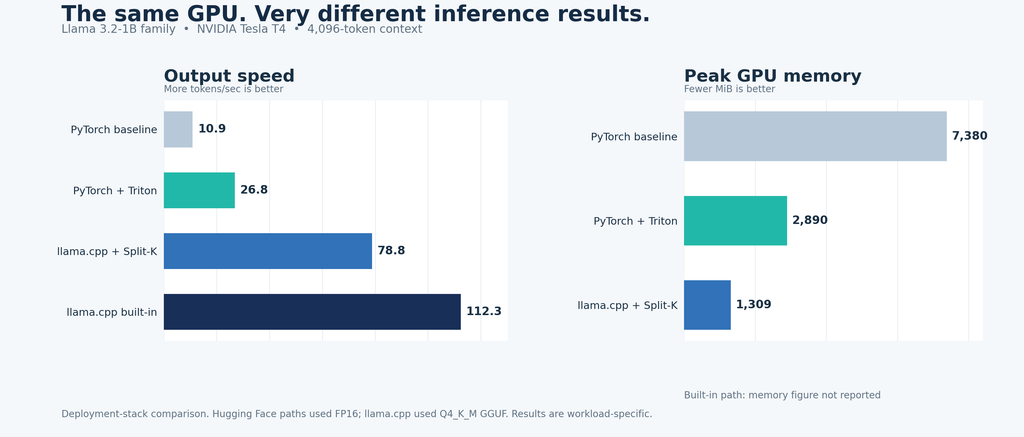
We tested that question with Llama 3.2-1B on an NVIDIA Tesla T4. We started with a Hugging Face/PyTorch path, then tested a custom Triton attention path and a native llama.cpp deployment with CUDA decoding. The model family and hardware gave us a concrete way to examine how different inference setups affect output speed and GPU memory use.
The results were really impressive. You can see the measurements and graphs in our accompanying case study.
Optimization goes beyond a faster kernel
A custom kernel can improve one part of inference, but the surrounding system matters too. Model format, KV-cache handling, runtime overhead, and the attention implementation all influence the final result.
Our Triton work explored targeted improvement within the PyTorch stack. The llama.cpp work required deeper runtime integration, including a validated CUDA decoding path and a quantized model. We also compared our implementation with llama.cpp’s built-in attention path to see how it stood against a mature production option.
That comparison is useful for anyone making a deployment decision. The best result may come from improving your current stack, or from changing the stack itself. The right answer depends on your model and workload.
What could this mean for your team?
Lower GPU memory use may leave room for longer contexts or more simultaneous requests. Faster generation may make your product feel more responsive. Whether those gains translate into lower costs depends on your traffic, hardware, and serving setup.
At Bynarycode, we help teams find out. We profile the existing inference path, identify where time and memory are going, and test focused changes against a clear baseline. That work can include Triton or CUDA kernels, KV-cache optimization, quantization, or runtime evaluation.
The goal is a practical answer: which changes improve your workload, and which are worth putting into production?
If inference speed or GPU cost is becoming a constraint, get in touch with Bynarycode. We can start with your current model and serving setup, then identify a focused benchmark that shows where optimization could help.